ICSI Treatment Myths Every Couple Should Understand
.webp)
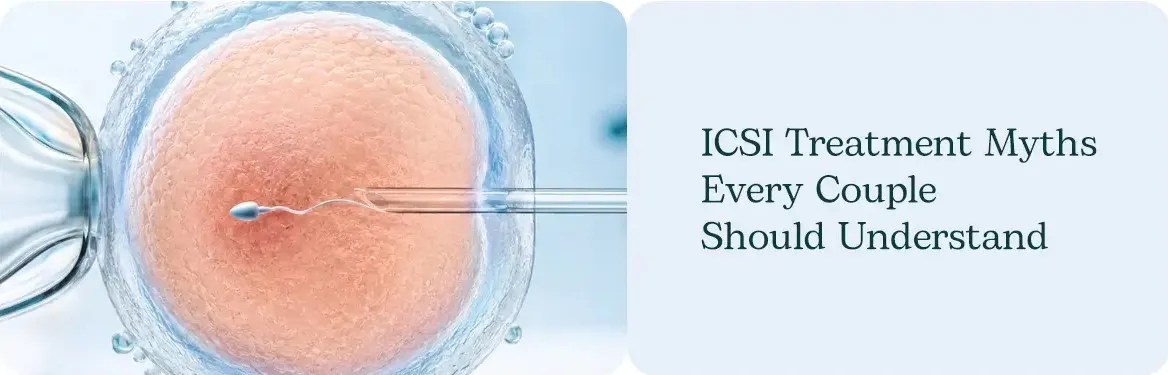
When couples begin fertility treatment, they often come across many new terms. IVF, IUI, ICSI, embryo transfer, sperm retrieval and fertilisation which can all sound overwhelming at first. Among these, ICSI is one treatment that often creates confusion.
ICSI stands for Intracytoplasmic Sperm Injection. It is a specialised laboratory technique used during an IVF cycle. In this process, a single selected sperm is injected directly into a mature egg to support fertilisation.
ICSI may be recommended when male fertility factors are present, such as low sperm count, poor sperm movement, abnormal sperm shape, surgically retrieved sperm or previous fertilisation failure during IVF. However, because many couples do not fully understand the procedure, several myths surround it.
Some believe ICSI is painful. Some think it guarantees pregnancy. Others assume it is only for severe male infertility or that it is always better than standard IVF. These myths can create unnecessary fear, delay treatment and make the fertility journey more stressful.
A clear understanding of ICSI can help couples make informed decisions with their fertility specialist.
How ICSI Myths Increase Stress for Couples
Myths around ICSI can make an already emotional fertility journey feel even more stressful. When couples hear that ICSI is painful, risky, unnatural or only meant for “serious” infertility cases, they may begin to feel anxious before they even understand the treatment properly.
For some couples, these myths create fear around the procedure. The woman may worry that ICSI will add more physical discomfort to the IVF cycle, even though ICSI itself happens in the laboratory after egg retrieval. The male partner may feel embarrassed if ICSI is recommended due to sperm-related concerns. This can create guilt, silence or emotional distance between partners.
Unrealistic expectations can also increase stress. Some couples may believe that ICSI guarantees fertilisation or pregnancy. If the outcome is different, they may feel shocked, disappointed or personally responsible. On the other hand, some may believe ICSI is too advanced or risky and may feel nervous about accepting the recommendation.
This is why clear counselling is important. When couples understand what ICSI can do, what it cannot promise and why it has been recommended in their specific case, the treatment feels less frightening. Correct information can reduce panic, support better decision-making and help both partners approach fertility care as a shared journey.
How ICSI Myths Can Delay the Right Treatment
Misunderstandings about ICSI can also delay timely fertility treatment. Some couples may avoid consulting a fertility specialist because they fear that ICSI means the problem is severe or that the treatment will be too complicated. Others may try multiple less suitable options because they are hesitant to accept IVF with ICSI.
In male-factor infertility, delay can be especially challenging. If sperm count, motility, morphology or sperm availability is affected, waiting too long may reduce the time available for proper evaluation and treatment planning. In some cases, the male partner may avoid testing due to embarrassment, which can delay semen analysis, hormone testing or sperm retrieval planning.
Myths can also delay treatment after a failed IVF cycle. If fertilisation was poor in a previous cycle, the fertility specialist may discuss ICSI for the next attempt. However, if the couple believes ICSI is unsafe or unnecessary, they may postpone the decision instead of understanding how it may help in their case.
Delays can add emotional and financial pressure. They may also make the journey more difficult for women of advanced reproductive age or those with low ovarian reserve, where time can be an important factor. This is why couples should not depend on online assumptions or hearsay. A personalised consultation can help them understand whether ICSI is truly needed and how it fits into the overall fertility plan.
Myth 1: ICSI and IVF Are the Same
ICSI is not the same as IVF, but it is performed as part of an IVF cycle.
In standard IVF, eggs and sperm are placed together in the laboratory, and fertilisation happens when a sperm enters the egg on its own. During ICSI, a carefully chosen sperm is injected directly into a mature egg by the embryologist to support fertilisation.
The remaining IVF steps may look similar. The woman undergoes ovarian stimulation, egg retrieval, embryo culture and embryo transfer. The main difference is how fertilisation is attempted in the laboratory.
Understanding this difference helps couples avoid confusion when doctors recommend IVF with ICSI.
Myth 2: ICSI Is Only for Severe Male Infertility
ICSI is often used for male-factor infertility, but that is not the only use. It may be recommended when sperm count is low, sperm movement is poor, sperm shape is abnormal or sperm has been retrieved through procedures such as PESA, TESA or Micro TESE.
However, ICSI may also be discussed in other situations. These may include previous fertilisation failure with IVF, use of frozen sperm, use of donor sperm in selected cases or specific treatment plans where the fertility team feels ICSI may support fertilisation.
That said, ICSI is not automatically needed for every couple. The decision should be based on semen analysis, egg quality, age, previous IVF history, the number of eggs retrieved and the couple’s overall fertility diagnosis.
Myth 3: ICSI Guarantees Fertilisation
ICSI can improve the chance of fertilisation in selected cases, especially when sperm-related issues are present. However, it cannot guarantee fertilisation.
Even after a sperm is injected into an egg, several things must still happen. The fertilisation must occur, the embryo must develop and the embryo must be suitable for transfer or freezing. Some eggs may not fertilise even after ICSI. Some embryos may stop developing.
This is why couples should see ICSI as a supportive laboratory technique, not a guarantee. It gives the fertility team more control over one part of the process, but it cannot control every stage of conception and pregnancy.
Myth 4: ICSI Is Painful for the Woman
ICSI itself is a laboratory procedure. It is performed on the egg and sperm after the eggs are retrieved. The woman does not feel the sperm being injected into the egg because that step happens outside the body in the embryology lab.
However, ICSI is part of an IVF cycle. So, the woman may experience the usual steps of IVF, such as injections for ovarian stimulation, ultrasound monitoring, blood tests, egg retrieval and embryo transfer. Egg retrieval is usually done under anaesthesia. It is more accurate to say that ICSI is not painful in itself for the woman. Any physical experience comes from the IVF process around it, not from the ICSI technique directly.
Myth 5: ICSI Is Always Better Than Standard IVF
ICSI is advanced, but that does not mean it is always the better choice for every couple. In cases of male infertility or previous fertilisation failure, ICSI can be extremely useful. But when sperm parameters are normal and there is no history of fertilisation problems, standard IVF may still be appropriate for some couples.
More advanced does not always mean more suitable. Fertility treatment should be personalised. The doctor and embryology team must consider the couple’s diagnosis, previous reports and treatment goals before deciding whether ICSI is needed.
This is why couples should ask, “Why is ICSI being recommended in our case?” rather than assuming it should be included automatically.
Myth 6: ICSI Can Solve Every Male Fertility Problem
ICSI can help overcome some sperm-related barriers, especially when sperm count, movement or fertilisation ability is affected. However, it does not treat the underlying cause of male infertility.
For example, if a man has a hormonal imbalance, infection, varicocele, genetic condition, high DNA fragmentation or azoospermia, these issues may need separate evaluation. In some cases, treatment, lifestyle changes, sperm selection techniques or sperm retrieval procedures may be required.
ICSI can help use available sperm more effectively, but male fertility evaluation remains important. A semen analysis, hormone testing, ultrasound, genetic testing or other investigations may be advised depending on the clinical situation.
Questions Couples Should Ask Before ICSI
Before starting IVF with ICSI, couples can ask their fertility team:
- Why is ICSI recommended in our case?
- Is the reason related to sperm count, motility, morphology or previous fertilisation failure?
- Will sperm need to be retrieved surgically?
- Are any advanced sperm selection techniques needed?
- What fertilisation rate can we realistically expect?
- What happens if some eggs do not fertilise?
- Should genetic counselling or testing be considered?
- How will embryos be monitored after fertilisation?
- What are the next steps after embryo transfer?
These questions can help couples feel more prepared and less anxious.
The best way to approach ICSI is with clarity
At Oval Fertility, we understand that fertility challenges can feel overwhelming, especially when male fertility factors are involved. Low sperm count, poor sperm motility, previous fertilisation failure, frozen sperm, surgically retrieved sperm or severe male fertility concerns can make the path to pregnancy more complex. This is where ICSI can offer a focused and advanced approach.
Our ICSI journey is designed with expert control, accuracy and patient comfort at every stage. It begins with a detailed consultation, where we review medical history, fertility goals and previous treatment outcomes. The ovaries are then stimulated to support the development of mature eggs, followed by egg retrieval through a guided, minimally invasive procedure under sedation.
At the same time, the sperm sample is prepared in the lab to isolate healthy and motile sperm. During the ICSI procedure, our embryology team uses an advanced microscope to inject one selected sperm into each mature egg. The resulting embryos are cultured and monitored carefully before the most suitable embryo is selected for transfer.
At Oval Fertility, we combine personalised fertility care with advanced embryology support, Japanese fertility technology, AI-powered insights and real-time embryo monitoring. Our aim is to give couples clarity, confidence and compassionate guidance through every stage of treatment.
We are here to help you understand your options and move ahead with care, precision and hope. To know more about our fertility treatment, contact our team.
It starts with a question. Our fertility experts
take it from there.
